

 10.6094/grid.2026.001 ·
3861 Wörter · ⌛ 20 Min.
Noel is a Postdoctoral Research Associate at Trinity Hall, University of Cambridge. She studies how the intensifying technological mediation of mobility continually remakes cities, producing new forms of space, publics, and politics.
“Netflix replaced TVs. Uber replaced private cars. Baemin will replace fridges,” Kim Bong-jin, founder of Baemin, boldly claimed (Gwak 2019). Baemin is the largest food delivery platform in South Korea, serving approximately 20 million regular users, nearly half of the country’s population. With meal and grocery deliveries becoming a daily practice in many Korean cities, Kim’s grand vision does not sound entirely unrealistic. Baemin now substantially coordinates the flow of food, people, vehicles, money, and information. As the platform continues to scale, it strives for smooth transport and operation with little or no friction, which reimagines and restructures urban spaces.
In this ethnographic essay, I offer a glimpse into what kinds of urban space cities may be turning into as they prioritise frictionless mobility, drawing on empirical research in Seoul and Gwanggyo, undertaking delivery work as a Baemin courier and interviews and follow-alongs with Baemin workers across 2021 and 2022. The three selected examples – dark kitchens, doorsteps, and delivery robots – highlight how the delivery platform’s pursuit of frictionless mobility materialises through contactless delivery, giving rise to spaces and infrastructures that discourage, eliminate, and invisibilise human-to-human contact. Attending to the relational politics of friction, I uncover the sociospatial changes implicated in Baemin’s scaling project, fuelled by a particular conception of friction. The essay closes by reflecting on how friction, when rethought through the work of Tsing (Tsing 2005) and other logistics and urban theorists, might offer pathways towards digitally mediated cities that are more inhabitable and accommodating.
Contact as friction
The pursuit of frictionless motion builds on the premise of urban and technological ideals. The smooth-flowing movement of capital, goods, and people has long been considered a utopian ideal for the modern city. Anything that interferes with efficient circulation is deemed a friction that must be eliminated (Woodcock 2023). Friction-free interaction and transaction are an unquestioned ethos in technology development, as manifested in Bill Gates’s “friction-free capitalism” and Facebook’s “Zero Friction Future.” Digital technologies are mobilised to bring a friction-free city to life, as envisioned by many smart city initiatives, entailing social, spatial, and infrastructural transformations.
Now, digital platforms, proliferating in many cities across the globe, aim for frictionless expansion and operation. Yet the universal platform logic of scalability inevitably meets with friction arising from specific culture, practice, and geography in place (Popiel and Vasudevan 2024). Furthermore, the aspiration for frictionless motion often comes up against friction inherent within the material and digital environments, especially with the prevalent possibility of infrastructural breakdowns (Chung 2024). The continual management of friction is thus crucial for platforms to scale and dominate space. Friction and the lack of friction are then the results of arrangements of power (Cresswell 2014).
While the vision of frictionless urbanism is not new, it takes shape in novel ways with delivery platforms discursively and materially. What is notable is their framing of human mobility and human contact as friction, claiming to save customers the hassle of movement through the mobility of things and envisaging a “city without (human) mobility,” in which people can order from home and stay home, enabled by new infrastructures for contactless delivery.
Inside a hidden, silent dark kitchen
The operation of platforms weaving into the urban fabric highlights “the everyday contingencies of the comings-together of platforms, cities, and urban residents” (Leszczynski 2020, 202). Such comings-together produce specific materialities, such as Airbnb condos, Uber cars, and Deliveroo riders (Söderström and Mermet 2020). To this, delivery platforms have added dark kitchens and dark stores. Unlike typical restaurants or supermarkets, these sites are built for the smooth circulation of food and grocery orders by minimising and controlling frictions and slowdowns in the process, through signs, numbers, and digital instructions, making verbal, human-to-human communication largely unnecessary.
Dark kitchens are unnoticeable from the outside. They are all situated in less visible and unprofitable locations, such as basements or peripheral alleys. Most of them are physically hidden away.
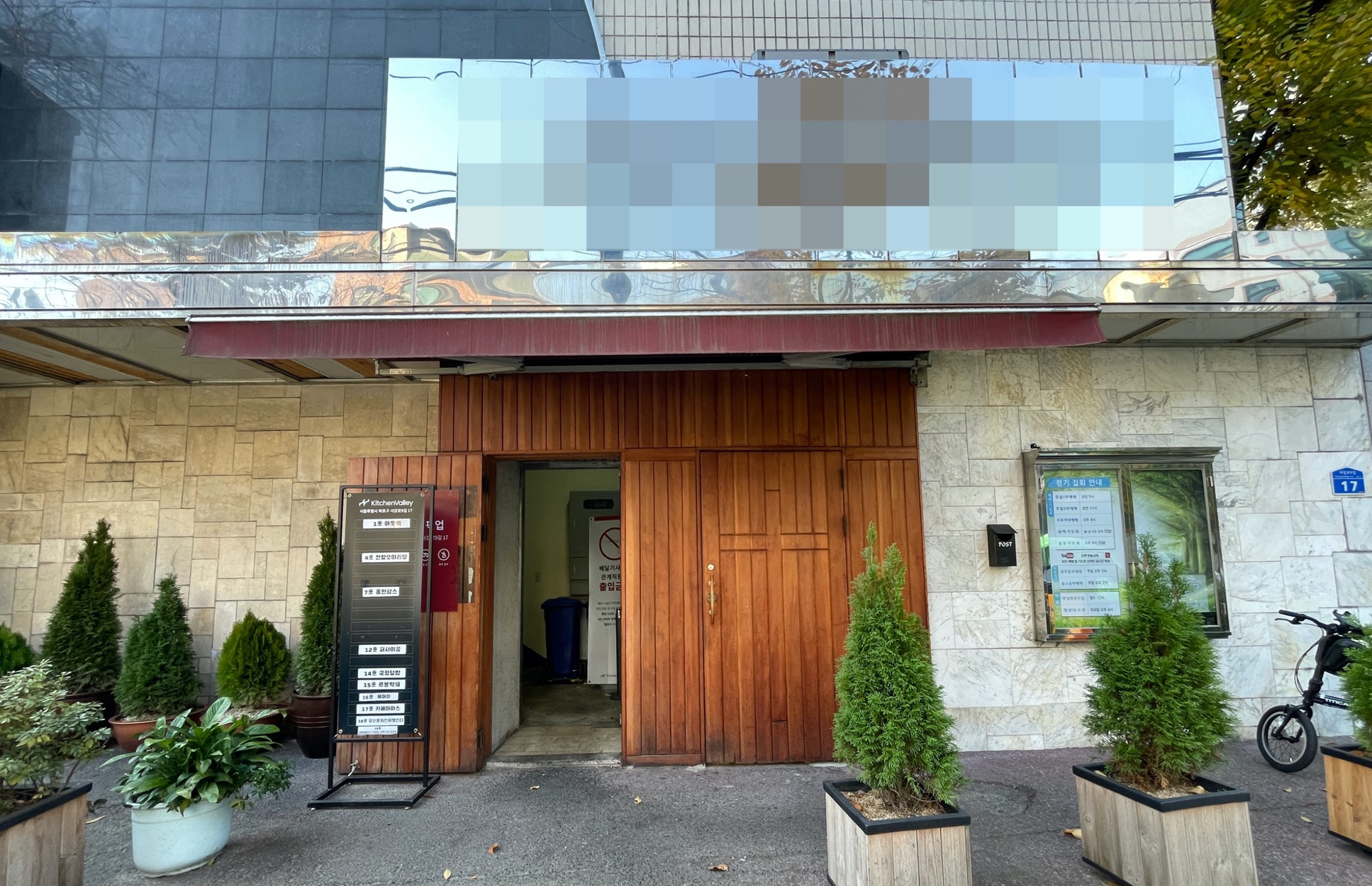
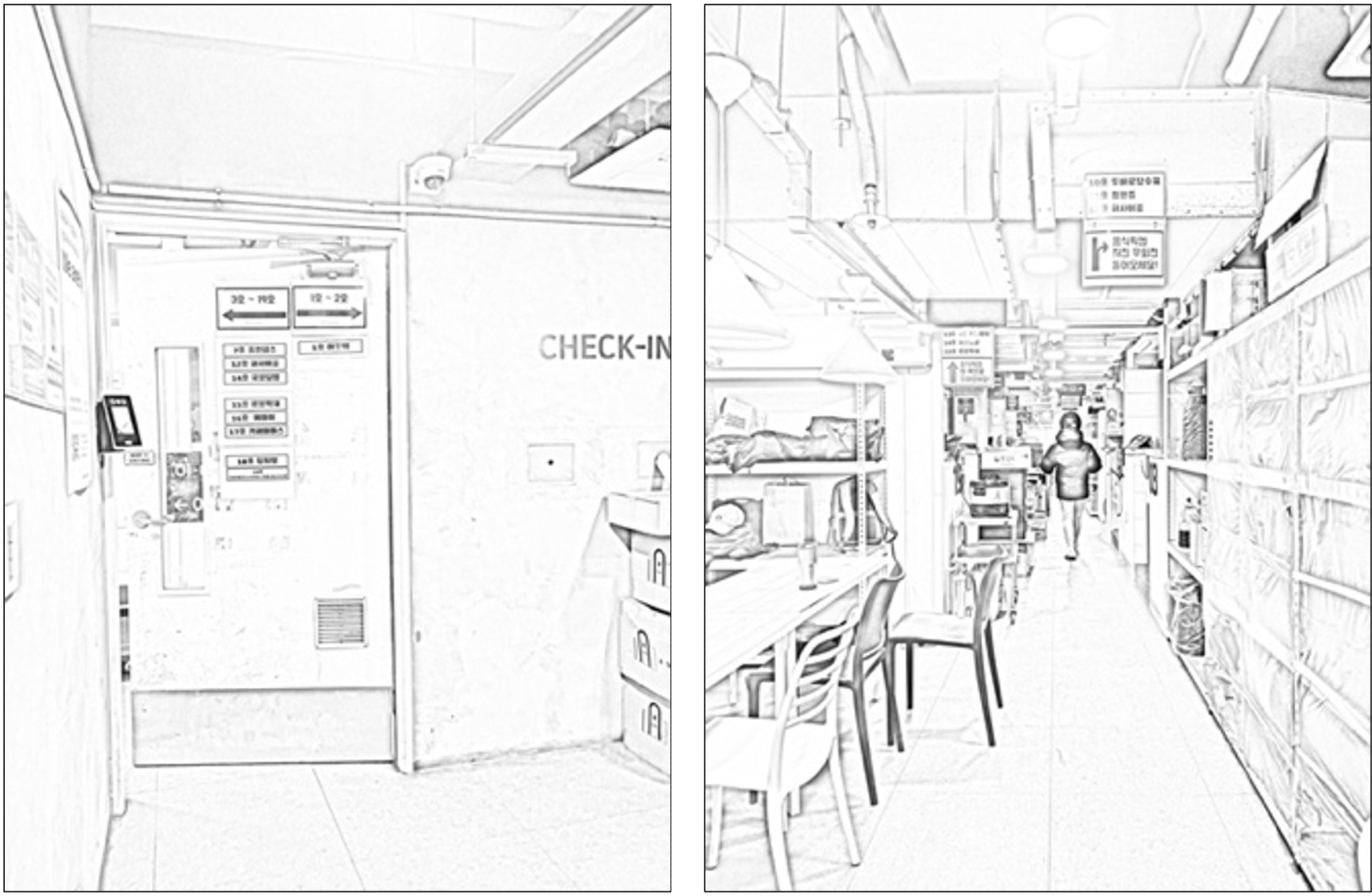
Dark kitchens are unnoticeable from the outside. They are all situated in less visible and unprofitable locations, such as basements or peripheral alleys. Most of them are physically hidden away. Some have visible signs, but none are marked as a restaurant on navigation apps; it is apt that they are also called ghost kitchens. On my very first visit as a courier to one of the dark kitchens, I struggled to locate it and wondered if my GPS had glitched because the visible part of the building was a Presbyterian church (see above photo). Although it seemed unimaginable to find a kitchen in this location, I dismounted my bike and entered the building because the Baemin map was clearly pointing in that direction. I then discovered small sticker signs and arrows on the wall intended for Baemin couriers. I went down the stairs leading to the basement, following the arrows. My fieldnote describes this moment as follows: “I was a bit nervous as if I were sneaking into a drug factory. I could tell why it’s called a ‘dark’ kitchen.”
I located the particular kitchen unit I had been called from, guided by arrows and numbers. While there were several kitchens, each with one or two staff members in it, no one was talking, and only the sound of cooking and packaging was heard. At first, I was struck by the absence of human voices, and they appeared irritated if I talked to them just to check whether my order was ready. Later, I came to realise that they might genuinely be too busy or exhausted. In the view of Jihoon, male part-time cycling courier, the people working in dark kitchens were becoming merely components of the system: “They cook and package (food) alone, over and over … They were like, you do your thing [i.e. delivering], I do my thing [i.e. cooking].” To enliven the space, Jihoon would deliberately say “Hello!” and “Goodbye!” in a loud voice – some greeted him back, others did not. He lamented that this lack of “human-to-human interactions,” replaced by robotised interactions, makes the space sterile, and then even “sucks the life out of the whole city.” Both couriers and cooks repeat the same set of machinic acts as required by the platform to enable continuous circulation within the city.
Peopleless exchanges at doorsteps
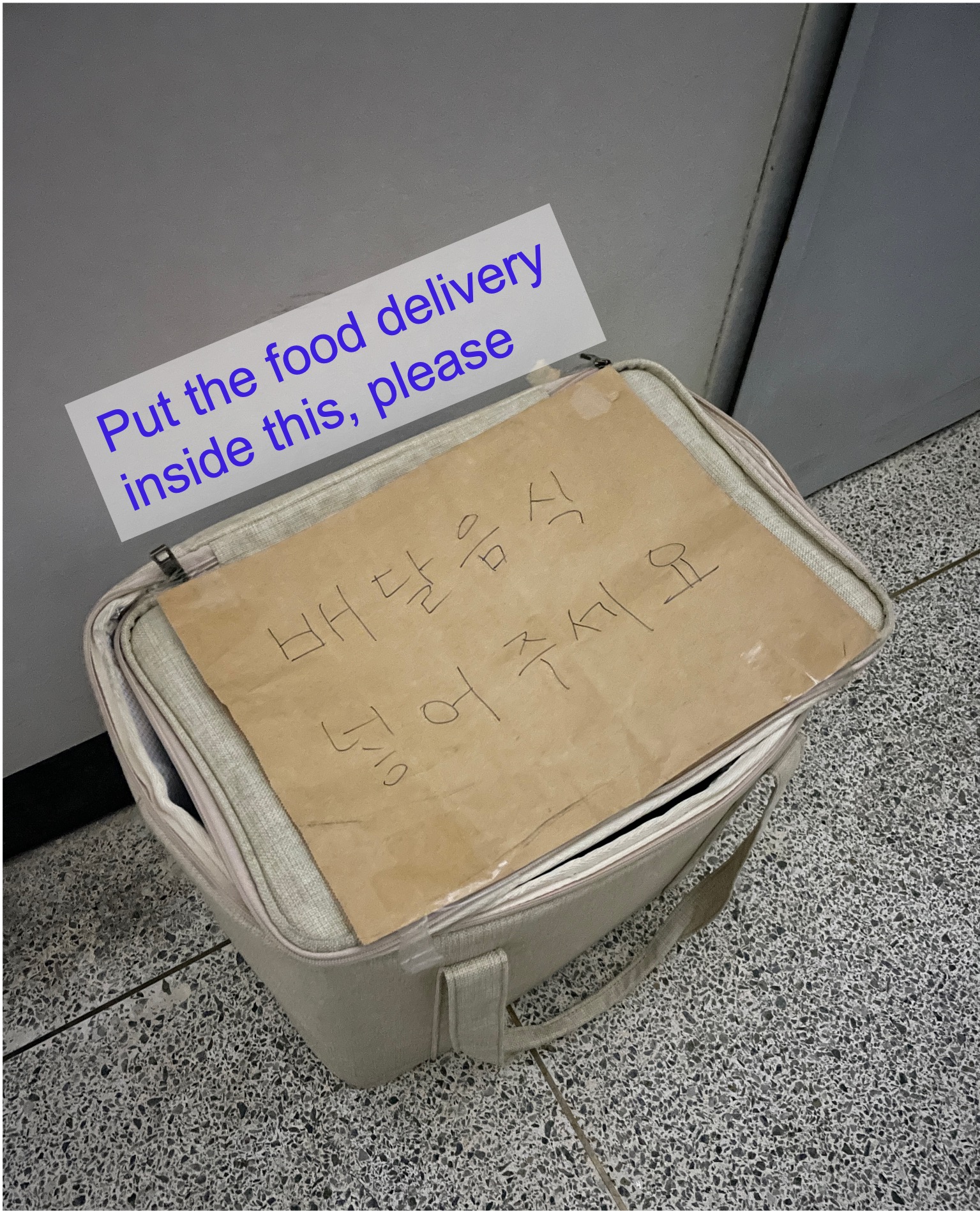
“Leave it at the doorstep and don’t ring the bell [문 앞에 두고 벨 X].”
“Leave it at the doorstep and don’t ring the bell [문 앞에 두고 벨 X].” For many Koreans, this has become a familiar refrain associated with food ordering/delivery using an app, as it is the most commonly used preset note to the courier. If dark sites are purpose-built, doorsteps have rather emerged accidentally as key infrastructures that facilitate deliveries free of human contact. As contact-free delivery became the norm since COVID-19, the doorstep, an unremarkable, unpeopled space, took on a new critical role in receiving deliveries. In fact, the role of doorsteps is expanding from contact-free deliveries to package returns, second-hand item transactions, and more, and the volume of anonymous visits and activities on the doorstep is growing. Delivery apps, including Baemin, typically coordinate contact-free delivery through real-time notifications and instructions, as well as a photo of the doorstep. Households that regularly receive meal or grocery orders would place one or more dedicated thermal bags on their doorsteps, which are becoming part of the doorstep assemblage, often attached with a message to couriers (see above photo).
Contactless delivery is preferred by both customers and couriers beyond COVID-19 for the convenience and safety that it enables. Even in the case of in-person deliveries, many customers would open their door wide enough to admit the food bag, but no wider. In my delivery experience, I saw more customers’ arms than faces. Female-only households are particularly concerned about safety and often prefer not to open the door to couriers who are overwhelmingly men. For part-time couriers, contact-free delivery helps them guard against the possible embarrassment of encountering an acquaintance, as Hyejin, female part-time on-foot courier, said: “I myself am fine with doing this job, but some neighbours may gossip about it”. For full-time couriers, in Sanghoon’s opinion, contact-free delivery helps reduce the likelihood of unpleasant interactions with rude customers.
These changes highlight the growing preference towards a mode of delivery that does not involve human-to-human contact. Platforms are contributing to solidifying this shift.
The Person Everyone is Waiting For (A delivery driver and his eldest daughter 2022) documents how the predominant method of receiving a delivery item has changed over time: from in-person deliveries to the recipient or a neighbour, to deliveries to a reception or security office, and then to impersonal, silent drop-offs at lockers and doorsteps. These changes highlight the growing preference towards a mode of delivery that does not involve human-to-human contact. Platforms are contributing to solidifying this shift. Beverungen (Beverungen 2024) notes that Amazon is remaking cities for logistical convenience, stripped of sociality by introducing new infrastructures and practices, such as Amazon Lockers and parcel delivery on porches. As he further observes, contactless delivery via lockers and doorsteps discourages human exchange and encounters, promoting atomisation over collectivisation.
Facing delivery robots, human presence invisibilised
The video clip shows Baemin’s delivery robot Dilly on duty in Gwanggyo, referred to as the Holy Land by Baemin employees, because Gwanggyo is Baemin’s first and the most advanced robot testbed site. I followed one of Dilly’s delivery journeys. A human Operator was accompanying the robot all the way, from start to end, indoors and outdoors. In the clip, the Dilly robot with an Operator moves to the pickup point, picks up the order, and heads to the delivery destination. The Operator, while stepping back as the restaurant staff and the robot interact, clears the way for the robot by lifting the overgrown branches and asks passers-by for their understanding as they walk past.
During my visit, I tried ordering an iced coffee via robot delivery to a playground, which did not go without friction.
“Although I saw a robot arriving at a playground where no one seemed to be waiting for a delivery, I wasn’t sure if it had come for me, as I did not receive any notification on my phone. I had a suspicion, but couldn’t approach the robot and check because … I was afraid I might accidentally trigger a sound. After a short while, a woman wearing a Baemin Robot vest appeared out of nowhere and asked me if I had ordered a coffee.”
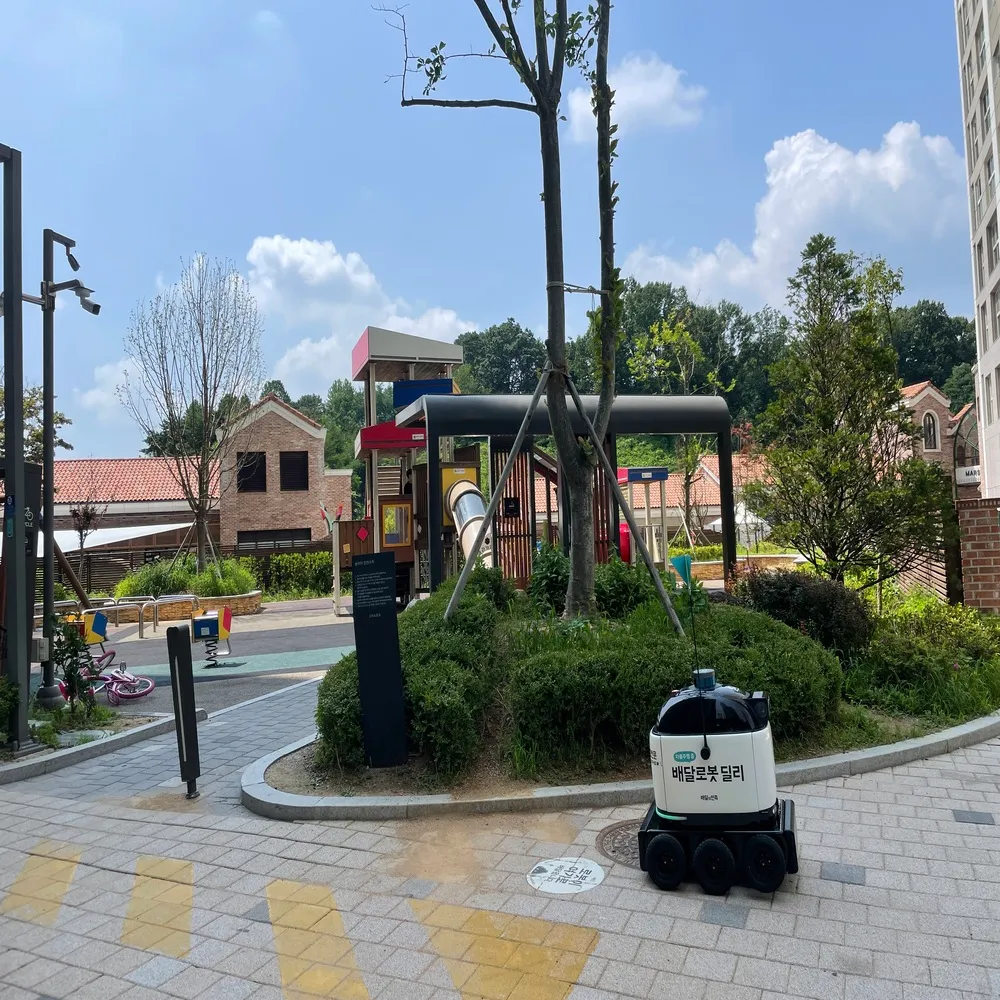
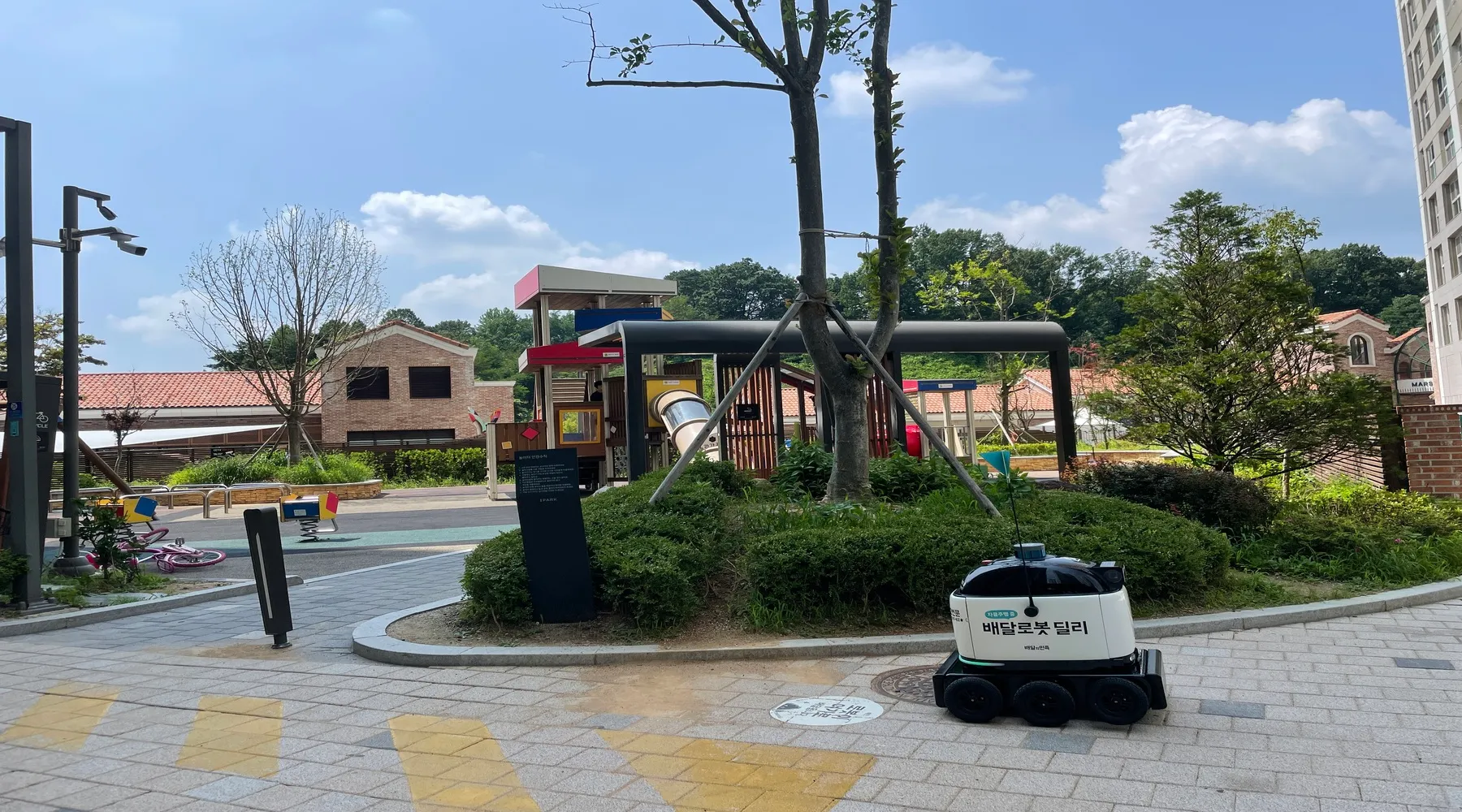
The fieldnote captures the scene where the human Operator came with the robot but hid somewhere nearby to make it a human contact-free interaction at the destination (see header image). Since I did not collect the order, the Operator, who was meant to be invisible, made an appearance to assist me. This echoes studies showing that automation tends to invisibilise or marginalise human labour, rather than replace it (e.g. Altenried 2020; Tubaro, Casilli, and Coville 2020; McElroy 2024).
These observations highlight the kinds of dis/connections and interactions that are being made with the deployment of delivery robots. People come into contact with robots more than with other people, whose presence is obscured – and the testbed residents appreciate robot delivery particularly for its contact-free experience. The robot could facilitate food delivery free of human contact, thanks to the human workers pretending not to be present and addressing frictions arising along the way. The accompanying human removing obstacles getting in the robot’s way hints at the spatial changes anticipated if robotic navigation is to be frictionless.
Kyungmin, from the Baemin Robotics Lab, emphasised during the interview that in fact, Kim, the founder, was initially motivated to invest in robotics to protect Baemin couriers from hazardous working conditions, such as riding in the rain. She further noted that robots will ensure precision and speed of deliveries at a lower cost, while also shielding human couriers from the risk of accidents. For on-demand platforms, heavy rain and snow have been among the biggest frictions that slow them down or may even cause a complete standstill. Furthermore, securing couriers in response to fluctuating demand is cited as the biggest problem.
Human couriers are costly, selective, vulnerable to accidents and inclement weather, and prone to “human errors”.
Human couriers are costly, selective, vulnerable to accidents and inclement weather, and, as Kyungmin remarked, prone to “human errors” – e.g. incorrect order pickups, inefficient routing, and misdeliveries. The deployment of robots is believed to address these human frictions, if they, while not perfect, become a little more precise, faster, and affordable than humans. While it might seem that Baemin maintains two distinct views towards human couriers: as subjects of protection and sources of friction, they collide in the drive to develop robots, i.e. human vulnerability becomes friction. As Lin (Lin 2022) claims, reducing dependence on vulnerable humans through automation and robotics is essential for making logistics infrastructure more resilient. He further argues that technologies once regarded as disciplining or replacing workers are now framed as solutions for “keeping workers safe … while keeping the wheels of logistics turning” (Lin 2022, 470). Then the pursuit of fluid logistics through robotics results in sidelining human workers who are destined to cause friction.
One year after my visits, in November 2023, new legislation came into effect, granting self-driving robots legal status as pedestrians, allowing them to operate autonomously on roads without human accompaniment. The associated amendments to the Intelligent Robot Act and the Road Traffic Act were enacted two years ahead of the initial roadmap, accelerated by industry pressure and the Korean government’s ambition to head start the global robotics race. With this in place, autonomous robots are expanding across public pathways and may soon become a pervasive presence – albeit unevenly across geographies, even within Seoul. Human pedestrians and vehicles are adapting, or struggling to adapt, to robot pedestrians’ materiality, mobility, and malfunctions, while calls have grown to overhaul the regulations to ensure the safety of all road users and establish liability in the event of accidents (KBS News 2026). It remains to be studied how this evolving robot-human co-presence may further reconfigure urban friction and contact.
Rethinking friction
The examples provide a window showing what kind of infrastructures and spaces Baemin-like platforms are creating and how they condition collective urban life. Urban public spaces are increasingly populated by technologies such as self-service kiosks, service robots, and driverless buses. They contribute to sustaining and speeding up the smooth-running city, further transforming the ways that people and things move and interact within it. Intervening in this broader shift, this essay has considered the delivery infrastructures that discourage, remove, and invisibilise human-to-human contact. Dark sites, doorsteps, and robots are mobilised to contribute to the smooth running of automated, sanitised, and segmented urban living, rendering the city a space of avoidance (cf. While, Marvin, and Kovacic 2021; Jacob 2015).
The project of creating a contact-free, and thus friction-free, city privileges connections for the smooth transport of things while driving out social connections. Cooks, dark site workers, couriers, and customers form nodes in a logistical chain, together with plastic containers, buildings, bikes, roads, signs, and doorsteps. Emerging mobility technologies allow people to stay in their friction-free bubbles, while machines are moving about on streets and in the air. But separation and segregation are “profoundly anti-urban impulses,” as Merrifield (Merrifield 2013, 66) notes. The same can be said for the infrastructures facilitating minimal or free of human contact. These ongoing changes are driven by a particular conception of friction, that is, anything that gets in the way of continuous, smooth circulation. The demand to move at the speed and pace of delivery platforms renders fellow urban actors and the interactions among them frictions to the flow.
Here arises the possibility that reframing friction can help envision alternative infrastructures and urban futures with digital technologies. Friction is not only inevitable and inherent, as mentioned earlier, but also desirable. This is further supported by Perng and Kitchen (2018), who argue that urban technologies are shaped by frictions, that is, encounters with different time-places, practices, and sociotechnical imaginaries. These encounters, or frictions, make visible the neglected, pressing urban issues. The ideas of encounters and intersections can contribute to creating more inhabitable cities with emerging technologies, beyond the spaces for control and circulation. Instead of separation, Merrifield (Merrifield 2013) advocates for a city that allows for swerve-like encounters, seeing comings-together and unpredictable encounters as key to urban living. Sassen (Sassen 2010) similarly stresses the importance of diverse and productive intersections and space-morphing by actual use, rather than rigidity.
When the drive for frictionlessness blinds us to the complexity of the real world, what are perceived as frictions and errors can create different conditions of visibility and new arrangements of power.
In practice, this would require reprioritising the application of new technologies to better serve the needs of communities, especially the marginalised, and diverse and changing uses. This might mean, for example, holding off the excitement for drone delivery of fried chickens to riverside parks, and instead prioritising the mobility rights for wheelchair users. Since December 2021, Korean wheelchair users demanding improved mobility rights have been staging prolonged protests. As a bold action, they have been occupying the busiest subway stations in Seoul and Daegu – a large city in the south of the country – to cause delays during rush hours by positioning themselves between the train and the platform, impacting passengers in their daily commute. The protesters have been largely blamed by the public for causing friction. This case acutely demonstrates the relational politics of friction. When the drive for frictionlessness blinds us to the complexity of the real world, what are perceived as frictions and errors can create different conditions of visibility and new arrangements of power, which can contribute to spatial and urban justice – also see Leszczynski and Elwood (Leszczynski and Elwood 2022) on errors and errata/corrections.
As Tsing reminds us, rather than a source of slowdown, friction, the “grip of encounter”, is what enables motion, like “a wheel turns because of its encounter with the surface of the road” (Tsing 2005, 12). Rather than frictionless motion, the city runs by the grip of encounter, in other words, friction. Following Tsing, Gregson, Crang, and Antonopoulos (Gregson, Crang, and Antonopoulos 2017) show how, contrary to the imagined seamless flow, frictions constitute an inherent part of heterogeneous logistical flows and highlight that “global connections are ‘made, and muddled, in friction’” (Gregson, Crang, and Antonopoulos 2017, 394). Likewise, we may say that cities are made, and muddled, in friction, that is, through encounters and intersections. Instead of reproducing and amplifying capsular life, alternative infrastructures we should be building would be the ones that facilitate productive friction, stimulating generative encounters for a city to permit disruption and discomfort.
Acknowledgements
This essay draws on material from Chung (Chung 2025), with sections reproduced and reworked from the original and new materials added.